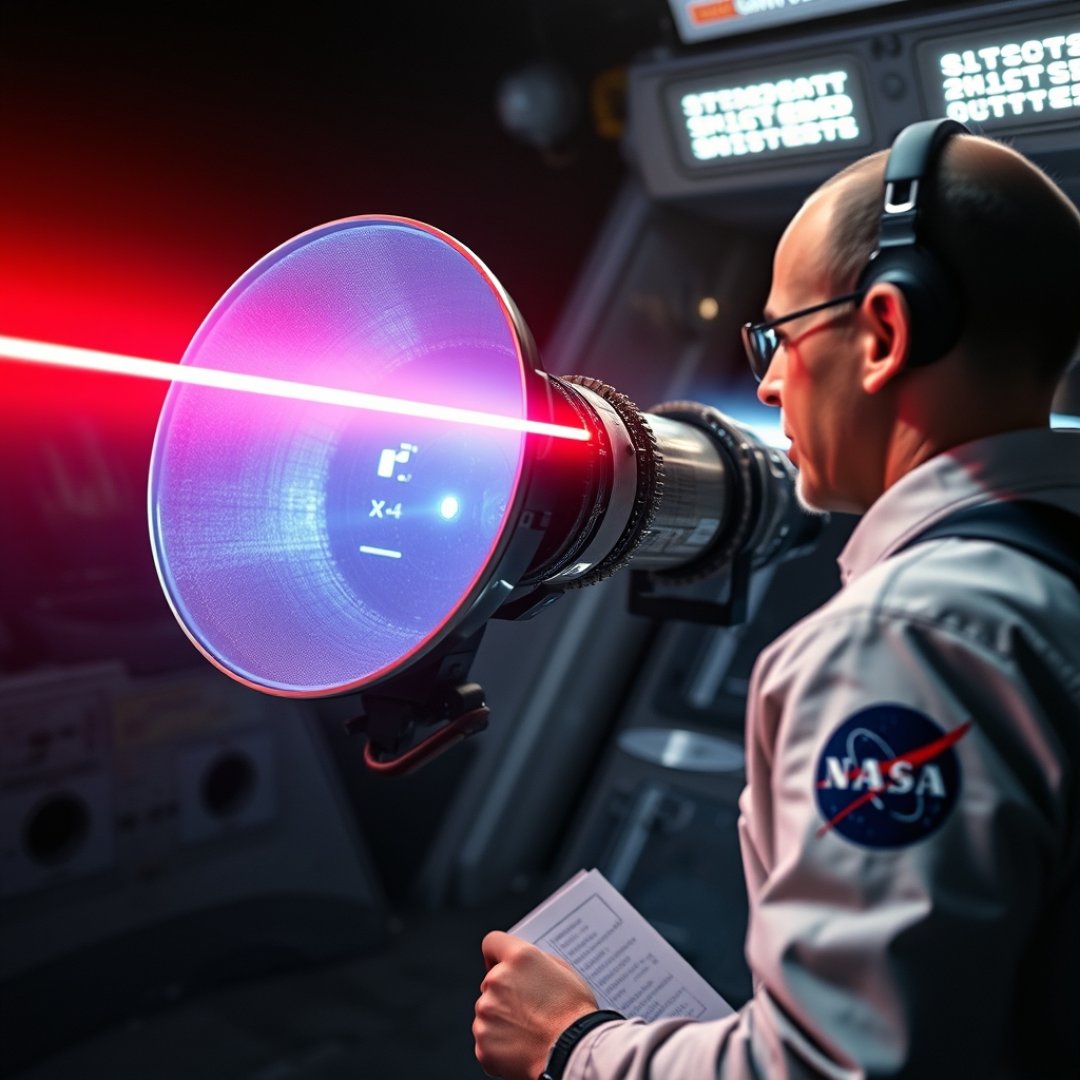
The upcoming Artemis III mission represents a monumental leap in human space exploration, aiming to return humanity to the lunar surface. Central to the success of this ambitious endeavor is the integration of advanced laser communication technology, which promises to transform how we exchange information between the lunar environment and Earth. As astronauts venture back to the Moon, the requirement for high-bandwidth data transmission becomes critical for high-definition video streaming, scientific data transfer, and robust mission control coordination. Unlike traditional radio frequency systems that have served space missions for decades, this optical upgrade leverages concentrated light beams to transmit massive amounts of data at significantly higher speeds. This technological shift is not merely an incremental improvement; it is an essential architectural evolution that will support real-time interaction, complex navigation, and the safety of our explorers in deep space. By transitioning from the limitations of bandwidth-constrained radio waves to the high-throughput capabilities of photons, NASA is setting a new standard for future interplanetary communication networks that will bridge the vast gap between our planetary bodies.
How Laser Communication Works in Deep Space
The Mechanics of Optical Data
At its core, laser communication technology utilizes infrared light pulses to encode information. Instead of relying on the broad dispersion of radio waves, these systems focus data into narrow beams. This allows for precision pointing that effectively targets receivers on Earth.
- Increased Bandwidth: By operating at higher optical frequencies, these systems can carry significantly more data than legacy RF systems.
- Point-to-Point Precision: Laser beams require pinpoint accuracy, necessitating sophisticated tracking and pointing mechanisms that compensate for the motion of both spacecraft and the Earth.
Advantages Over Traditional Radio Systems
Why We Are Moving Beyond Radio
While radio frequencies (RF) have been the backbone of space travel since the Apollo era, they face physical limitations regarding spectral crowding and data capacity. Optical communications offer a distinct advantage for future lunar habitation and exploration.
Key Benefits
- Reduced Size and Power: Optical hardware is often lighter and consumes less electrical power, which is a premium asset on weight-sensitive lunar modules.
- Secure Transmission: Because the beams are highly directional, they are much harder to intercept or jam compared to the omnidirectional nature of radio broadcasts.
- Speed of Insight: High-definition video from the lunar surface can be sent back to Earth almost instantaneously, enabling scientists to participate in exploration as it unfolds.
Bridging the Gap to Mars Exploration
A Gateway to Further Horizons
The development of this technology for the Artemis program is not just about the Moon; it is a foundational testbed for future crewed missions to Mars. Communicating with astronauts millions of miles away requires the kind of reliability and data density that only light-based systems can realistically provide.
Future Applications: As we look toward the 2030s, the scaling of this technology will allow for a dedicated ‘Lunar Internet’ that supports permanent surface bases, robotic outposts, and continuous deep space observation. Successfully implementing this during Artemis III marks the point where space exploration truly shifts into the digital age.
Frequently Asked Questions
What is the main advantage of laser communication over radio?
The primary advantage is bandwidth; laser systems can transmit data at much higher speeds, allowing for high-definition video and large scientific data packets to be sent much faster than traditional radio waves.
Will laser communication replace radio entirely?
Initially, no. Laser communication will likely serve as a high-speed supplemental system, with radio remaining as a robust, all-weather backup due to its ability to penetrate clouds and atmosphere more effectively.
How do lasers stay aimed at Earth from the Moon?
The spacecraft uses highly advanced gimbaled mirrors and sophisticated computer-aided pointing systems that constantly adjust for the relative motion of the Earth and the lunar landing site.