
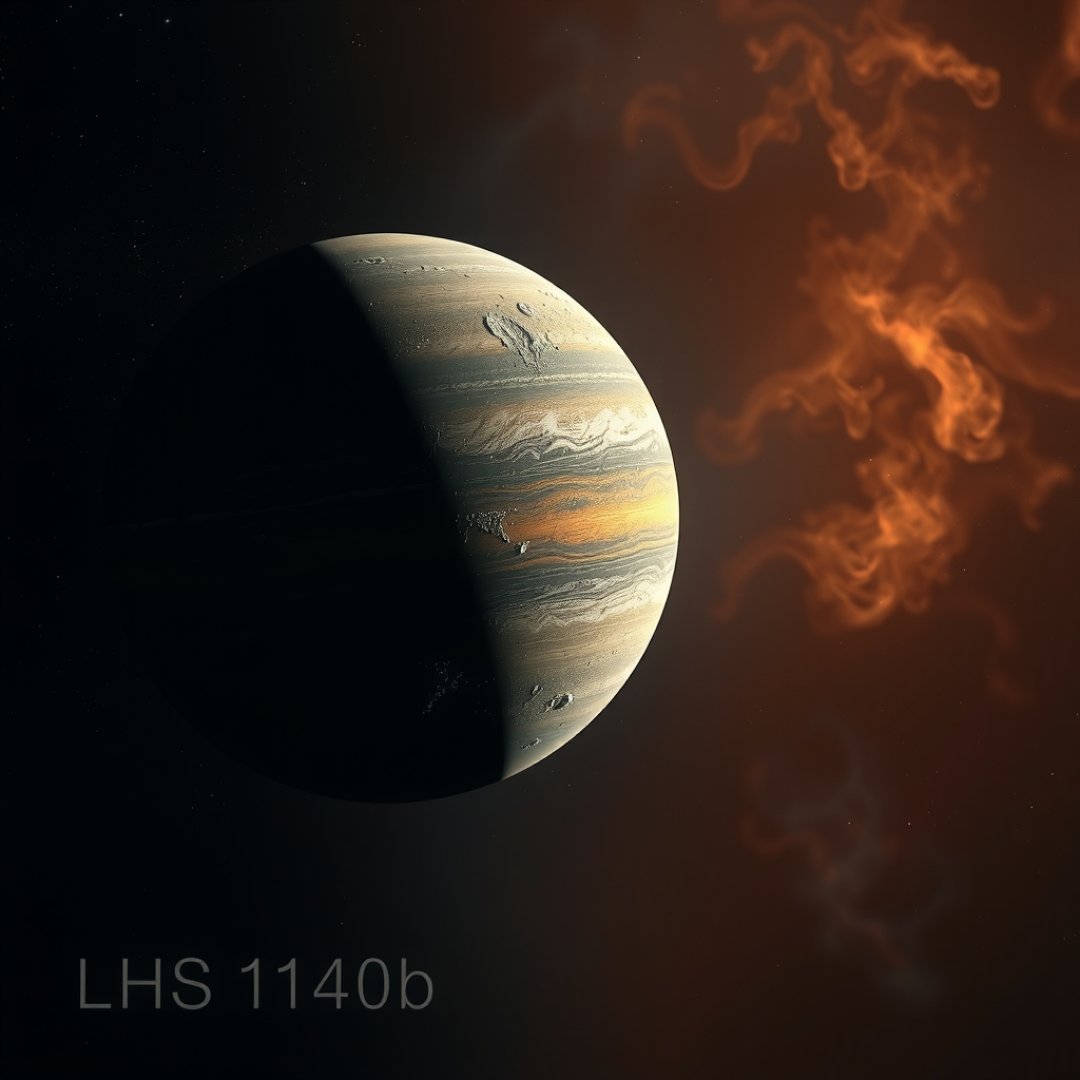
Located approximately 48 light-years from Earth, the exoplanet LHS 1140b has emerged as a premier target for modern astrobiology. Unlike many other M-dwarf planets that suffer from intense stellar radiation, this super-Earth resides in the conservative habitable zone of its host star. Recent data from the James Webb Space Telescope (JWST) have provided unprecedented insight into its physical nature, fueling intense interest in the LHS 1140b atmospheric composition observation potential. By analyzing the way starlight filters through the planet’s outer layers during transit, scientists are attempting to detect the presence of volatile compounds like water vapor, nitrogen, or carbon dioxide. Understanding this composition is vital because it acts as the primary indicator of whether the planet possesses a stable climate capable of harboring liquid water or even biological processes on its surface.
The Promise of M-Dwarf Planetary Systems
Why LHS 1140b Stands Out
Most planets discovered orbiting M-dwarf stars are plagued by high levels of stellar activity, which often strips away secondary atmospheres. However, LHS 1140b is unique because it orbits a relatively quiet, older star. This relative stability preserves the LHS 1140b atmospheric composition observation potential by allowing the atmosphere to persist over billions of years.
Technical Advantages for Astronomers
- Reduced Stellar Noise: The host star exhibits less frequent flaring compared to stars like TRAPPIST-1.
- Planet Density: Its high mass suggests a rocky composition, increasing the likelihood of an outgassed atmosphere.
- Observational Alignment: The transit depth is significant enough to allow JWST to gather high-signal-to-noise spectra.
Methods for Detecting Atmospheric Gases
Transmission Spectroscopy Explained
The primary method for studying the atmosphere involves transmission spectroscopy. As LHS 1140b passes in front of its host star, the starlight is filtered through the planet’s thin gaseous limb. Certain wavelengths are absorbed by gas molecules, creating a unique chemical fingerprint.
Targets of Interest
Researchers are specifically looking for:
- Water Vapor: The hallmark indicator of potential oceans.
- Carbon Dioxide: A key greenhouse gas that hints at geological activity and temperate regulation.
- Methane and Ammonia: Potential biosignatures that, if found in non-equilibrium concentrations, could signal the presence of biological life.
Challenges in Future Observations
Distinguishing Between Haze and Atmosphere
One of the greatest hurdles in assessing the LHS 1140b atmospheric composition observation potential is the presence of aerosols or high-altitude hazes. These particles can mask the spectral signals of underlying gases, making it difficult to discern exactly what lies beneath the upper layers. Future observations will require longer integration times to pierce through these potential cloud decks.
Next-Generation Instrumentation
While the JWST is currently the gold standard, future missions, such as the Extremely Large Telescope (ELT), will provide the resolution needed to conduct direct imaging or high-resolution spectroscopy, further confirming the findings gathered by current space-based assets.
Frequently Asked Questions
Why is LHS 1140b considered a super-Earth?
LHS 1140b is classified as a super-Earth because its mass and radius are significantly larger than Earth’s, yet it remains smaller and less gaseous than mini-Neptunes, suggesting a predominantly rocky internal structure.
Can we confirm life on LHS 1140b right now?
No, current data only allow us to analyze the potential for atmospheric gases. Confirming life would require the unambiguous detection of biosignature gases in ratios that cannot be explained by non-biological geological or atmospheric processes.
How long does it take for JWST to observe this planet?
Transit observations require multiple events to be stacked to reduce noise, meaning researchers typically need to observe several orbits—which can span several months to a year—to obtain high-quality data.