
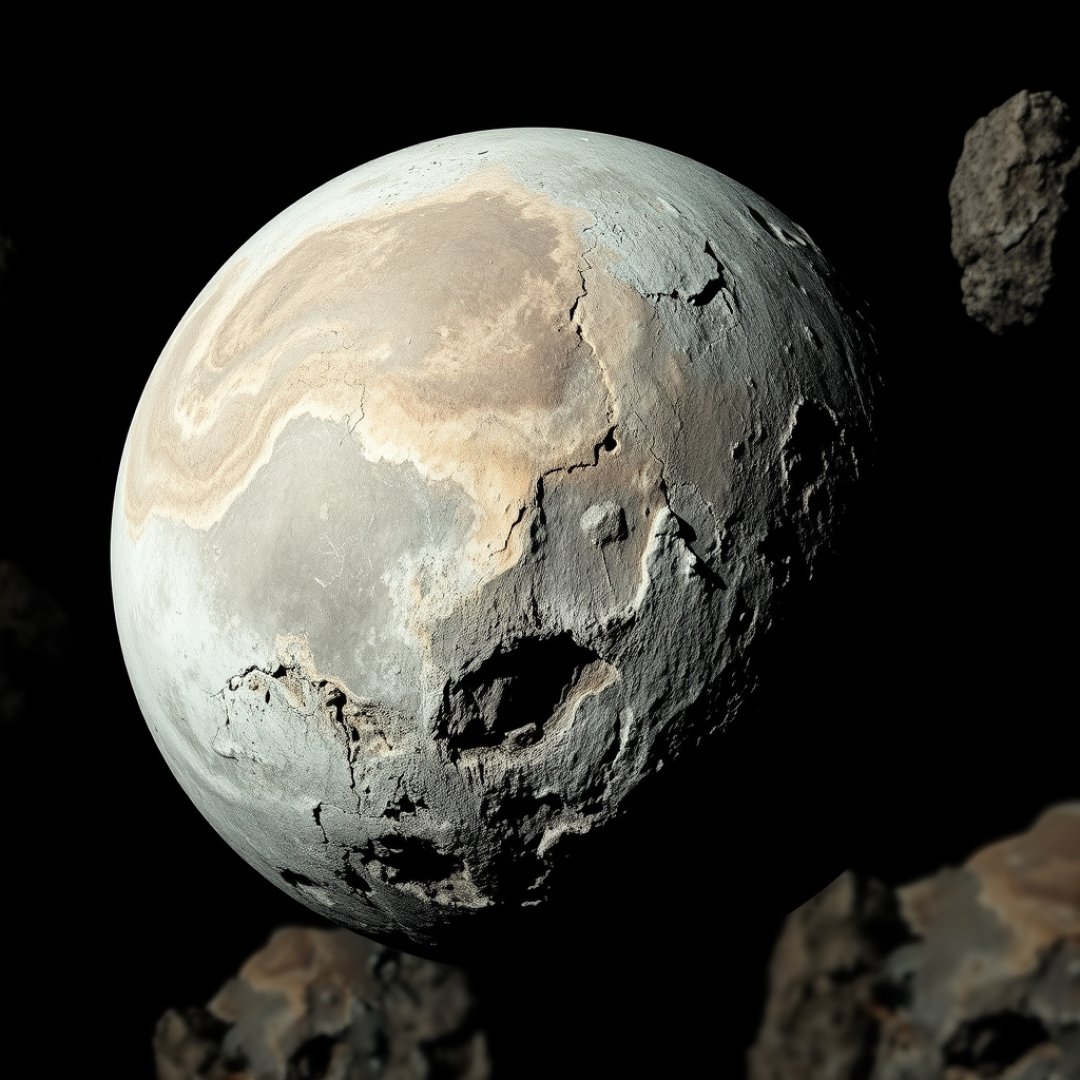
When studying the Pluto-Charon binary system, it becomes clear that Charon geological history is inseparable from the violent and dynamic forces that shaped the outer reaches of our solar system. Long ago, these bodies were not the gracefully spinning, tidally locked pair we see today. Instead, they underwent a tumultuous evolution driven by massive gravitational interactions that eventually led to a significant rotational deceleration. Understanding this transition is crucial for planetary scientists, as it reveals how tidal forces can completely alter the surface topology and internal structure of icy moons. By analyzing the tectonic scars and surface features captured by the New Horizons spacecraft, we can map out a timeline of crustal fractures and thermal shifts, which together define the unique Charon geological history that transformed the moon from a volatile, spinning world into the stable, crater-pitted sphere that orbits Pluto today.
The Evolution of Rotational Deceleration
How Tidal Forces Shape Orbits
The process of rotational deceleration occurred as Charon and Pluto exchanged angular momentum through intense tidal dissipation. Early in the history of the system, both bodies spun rapidly on their axes. As they orbited each other, the gravitational bulges created by their proximity caused significant friction within their icy mantles. This energy loss acted as a braking mechanism, slowing down their rotation until they reached a state of synchronous rotation, or tidal locking.
- Tidal Dissipation: The transformation of kinetic energy into heat as the bodies flexed.
- Angular Momentum Transfer: The redistribution of energy that forced the two bodies to face each other permanently.
- Final Locking: The point at which the orbital period matched the rotational period of both bodies.
Surface Evidence of Geological Change
Tectonic Signatures on the Moon
The geological history of Charon is etched into its surface via expansive tectonic systems, most notably the Serenity Chasma. These massive canyon systems indicate that the moon likely possessed an internal, liquid-water ocean during its early formation. As the interior froze, the expansion of the water caused the crust to crack, creating the deep chasms that define much of the moon’s surface today.
Key surface features include:
- Extensive Rifting: Giant crustal fractures spanning thousands of kilometers.
- Smooth Plains: Regions like Vulcan Planum, which suggest cryovolcanic activity that smoothed over older cratered landscapes.
- Crater Density: Variations in impact cratering that allow scientists to date the different surface ages across the moon.
Why the Pluto-Charon System Matters
Lessons for Exoplanetary Science
Studying Charon is not merely an exercise in understanding a single moon; it is a vital window into the broader physics of binary planet-moon systems throughout the universe. Because Charon is so large relative to Pluto, it serves as a laboratory for studying dual-body mechanics that are otherwise rare in our immediate neighborhood. The deceleration process observed here provides a predictive model for other tidally locked exoplanetary systems, helping astronomers understand how planets and their satellites move and evolve over billions of years.
Frequently Asked Questions
Is Charon still slowing down its rotation?
No, Charon is now tidally locked to Pluto, meaning it rotates once on its axis for every one orbit it completes around Pluto, keeping the same face directed toward the planet.
What caused the massive cracks on Charon’s surface?
Most researchers believe these cracks were caused by the freezing of an internal subsurface ocean, which forced the outer crust to expand and fracture.
Did Charon always look the way it does today?
No, early Charon was likely much warmer due to internal heat and tidal forces, leading to volcanic activity that resurfaced parts of the moon before it fully cooled and stabilized.