
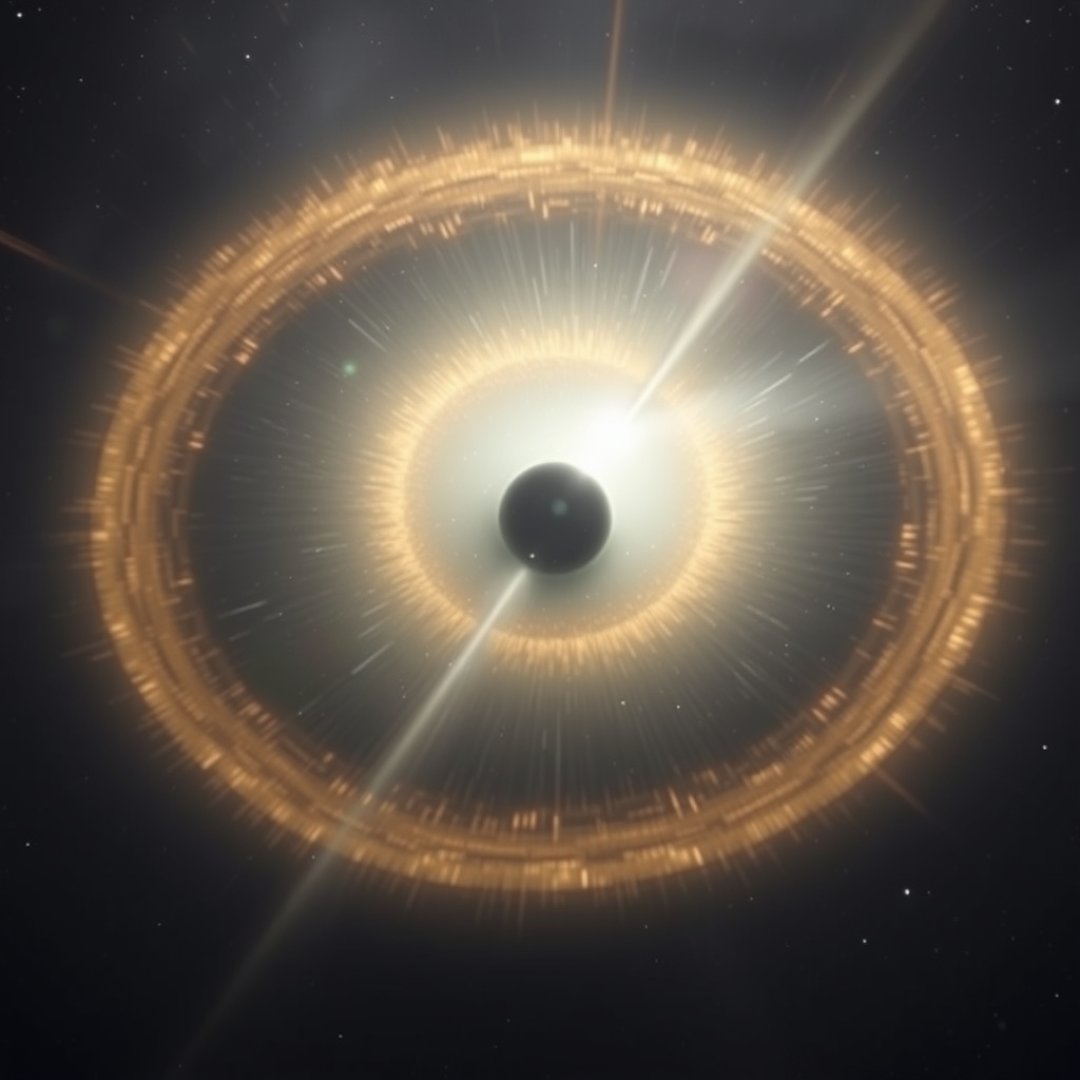
When massive stars collapse at the end of their life cycles, they often leave behind incredibly dense, magnetized remnants known as neutron stars. Among these, pulsars represent a subset that emits beams of electromagnetic radiation from their magnetic poles, creating a lighthouse-like effect as they spin at immense speeds. The precise pulsar rotation frequency measurement physics allows scientists to track these objects with staggering accuracy. Because these rotations are remarkably stable, they serve as cosmic lighthouses, providing researchers with the data necessary to probe the fundamental laws of gravity, study the interstellar medium, and even detect elusive gravitational waves rippling through the fabric of spacetime.
The Mechanics of Pulsar Spin
Conservation of Angular Momentum
The core of a neutron star inherits the angular momentum of its progenitor star, but compressed into a sphere only about 20 kilometers in diameter. According to the law of conservation of angular momentum, as the radius shrinks, the rotation speed must increase drastically. This process results in neutron stars spinning hundreds of times per second.
Magnetic Alignment and Emission
Pulsars are defined by their strong magnetic fields, which are misaligned with their rotation axes. This misalignment forces charged particles to accelerate along the magnetic field lines, producing intense beams of radiation. As the star rotates, these beams sweep across the Earth, manifesting as regular pulses that we measure to determine the star’s period.
Techniques in Signal Timing
Arrival Time Analysis
Measuring the frequency requires tracking the exact arrival times of pulses at a radio telescope. Astronomers account for several variables:
- Dispersion delay: Correcting for the slowing effect of free electrons in the interstellar medium.
- Earth motion: Accounting for the Doppler shift caused by the Earth orbiting the Sun.
- Barycentric corrections: Adjusting for the motion of the solar system center relative to the pulsar.
Integration and Long-term Stability
By collecting millions of pulses over several years, scientists can average out noise to achieve a timing model. The stability of these rotations rivals that of the best atomic clocks on Earth, making them essential tools for galactic navigation and fundamental physics experiments.
Why Pulsar Timing Matters
Probing Spacetime Geometry
Pulsar rotation frequency measurement physics enables the testing of Einstein’s General Relativity. In binary systems where two neutron stars orbit each other, the energy loss through gravitational waves causes the orbit to decay, which in turn alters the observed pulsar period. By measuring these changes, astronomers have confirmed the existence of gravitational waves.
The Search for Background Waves
Large-scale projects, such as Pulsar Timing Arrays (PTAs), monitor dozens of pulsars simultaneously. By looking for correlated timing deviations across the sky, researchers hope to detect the hum of a cosmic gravitational wave background, likely created by supermassive black hole binaries merging in the distant universe.
Frequently Asked Questions
What exactly is a pulsar?
A pulsar is a highly magnetized, rotating neutron star that emits beams of electromagnetic radiation from its magnetic poles.
How do scientists measure the spin of a pulsar?
Scientists use radio telescopes to record the precise arrival times of pulses, then apply mathematical models to compensate for Earth’s motion and interstellar interference.
Why are pulsars considered good clocks?
Because pulsars have enormous mass and spin at such high speeds, their rotation is incredibly stable, resisting fluctuations much better than conventional mechanical or electronic timing devices.