Betelgeuse, the prominent red supergiant in the Orion constellation, has long captivated astronomers due to its unpredictable behavior and dramatic shifts in luminosity. At the heart of this phenomenon lies complex stellar variability mechanics that govern how the star pulsates, loses mass, and undergoes periodic cycles of contraction and expansion. By observing these changes, scientists are gaining unprecedented insight into the late-stage evolution of massive stars. Understanding these stellar variability mechanics is not merely an academic exercise; it provides a direct window into the life cycle of stars that eventually forge the heavy elements necessary for life. As Betelgeuse nears the end of its life, its surface dynamics and cooling events offer a unique laboratory for testing hydrodynamic models of high-mass stars, forcing us to reconsider the limitations of our current predictive stellar physics models.
The Physics of Pulsation and Convection
Radial Oscillations
Betelgeuse undergoes semi-regular pulsations that cause its radius to expand and contract over hundreds of days. This process is driven by the opacity mechanism, where the stellar interior traps heat, creating pressure imbalances that force the outer layers outward. As the star expands, it cools, which subsequently releases the pressure and allows gravity to pull the mass back in.
Convective Cell Dynamics
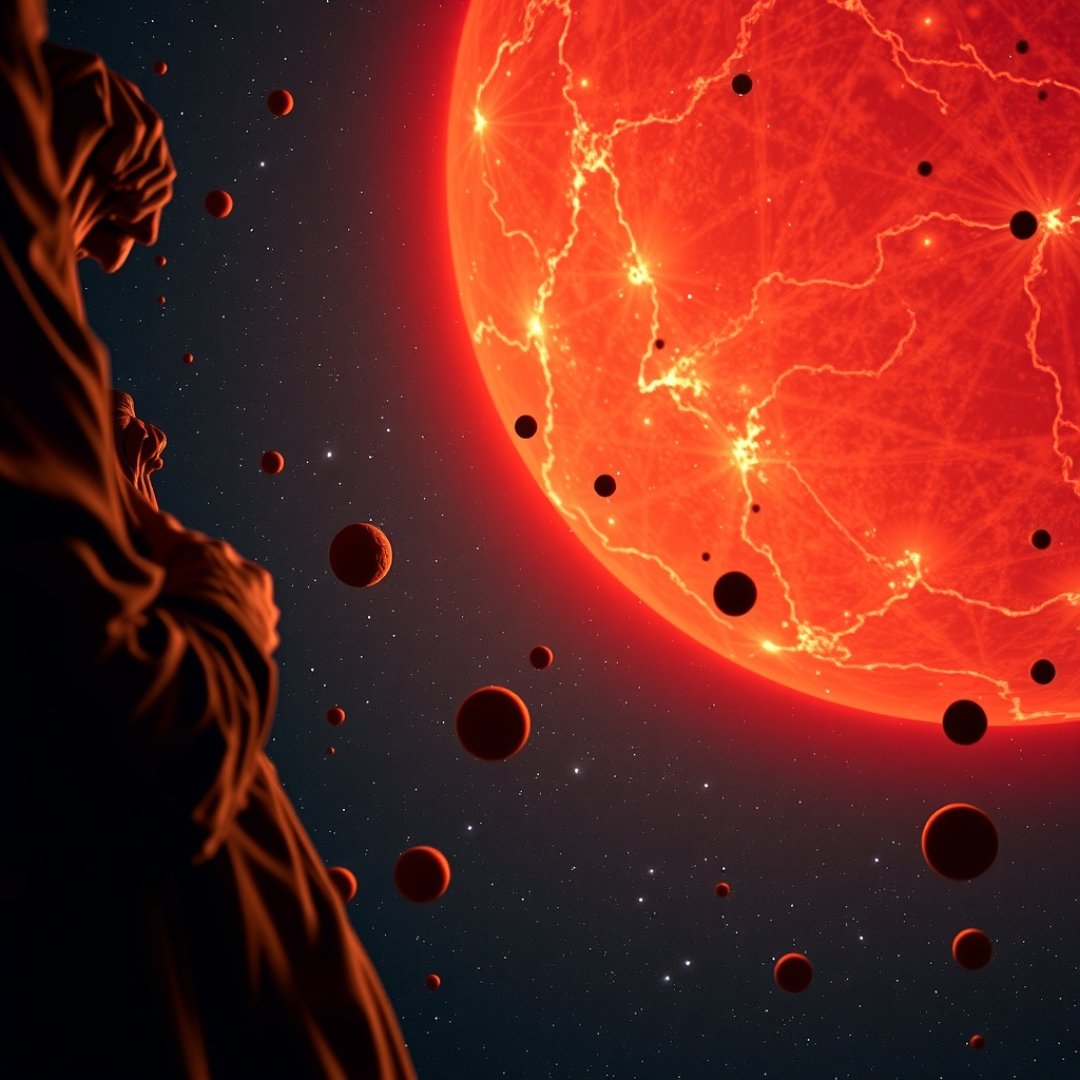
Unlike our Sun, Betelgeuse features massive, localized convection cells that cover significant portions of its visible disk. These cells transport energy from the core to the surface. When a gargantuan convection cell rises and cools, it can lead to localized dimming events, which observers on Earth often interpret as potential pre-supernova activity.
Mass Loss and Dust Formation
Ejection Events
The stellar variability mechanics are intrinsically linked to mass loss. Because the star has such low surface gravity, even minor pulsations can lift gas high above the photosphere. Once the gas cools at a distance, it condenses into dust grains.
Obscuration by Dust
- Condensation: Metallic elements condense into solid particles.
- Radiation Pressure: Stellar light pushes these dust clouds away, dragging gas with them.
- Interstellar Contribution: This mass loss contributes significant material to the surrounding interstellar medium, effectively seeding future star systems.
The Significance of Monitoring Dimming Events
Analyzing the Great Dimming
In 2019, Betelgeuse experienced a historic drop in magnitude that sparked global scientific interest. Spectral analysis revealed that this was likely a combination of a massive surface cooling event followed by the ejection of a dust cloud that obscured our line of sight.
Why It Matters for Astrophysics
By monitoring these events, researchers refine the timing of the eventual supernova. While Betelgeuse remains stable on a human timescale, these fluctuations are snapshots of a chaotic transition period, providing critical data for calibrating the evolution of red supergiants across the galaxy.
Frequently Asked Questions
Is Betelgeuse about to go supernova?
While Betelgeuse is nearing the end of its life, it remains in the red supergiant phase. It could explode within the next 100,000 years, but it is not showing immediate signs of a collapse.
What causes the dimming of Betelgeuse?
Dimming is primarily caused by complex atmospheric dynamics, specifically the ejection of gas that cools and turns into dust, which blocks the star’s light.
How do astronomers measure these stellar changes?
Astronomers use a combination of ground-based interferometry to image the surface, spectroscopy to analyze chemical compositions, and long-term photometric monitoring.