
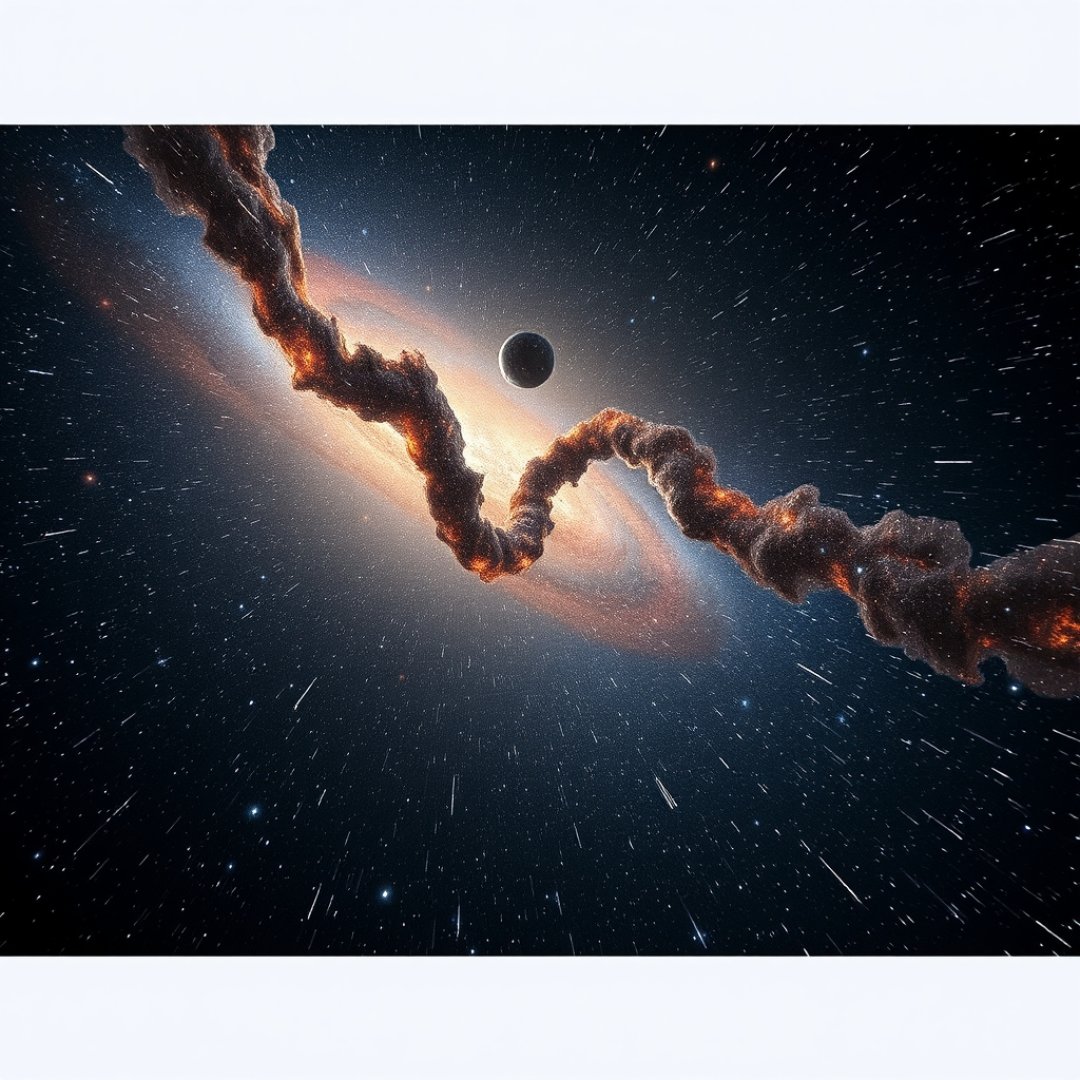
Deep within the vast expanse of the cosmos, extragalactic stellar streams serve as delicate, thread-like cosmic markers that trace the history of galactic interactions. These elongated groups of stars, originally torn from globular clusters or dwarf galaxies by intense tidal forces, provide an unparalleled window into the invisible structure of the universe. By analyzing the structural integrity and trajectory of these formations, researchers can map the distribution of mass that governs galactic architecture. The primary driver behind these peculiar, stretched configurations is the pervasive dark matter influence, a mysterious substance that exerts gravitational pull without emitting light. Understanding these streams is not merely an academic exercise; it is essential for decoding how galaxies grow, collide, and maintain their shape over billions of years, ultimately revealing the hidden scaffolds upon which all visible matter resides in our universe.
The Mechanism of Tidal Disruption
How Streams Form
Stellar streams originate when a smaller satellite galaxy or a dense star cluster ventures too close to a larger galaxy. The massive gravitational gradient of the host galaxy exerts a differential pull, effectively stripping stars away from the intruder. This process creates a tidal tail that stretches along the orbital path.
The Role of Tidal Forces
- Gravitational Gradients: These forces create the stretch needed to pull stars from their original host.
- Orbital Decay: Friction caused by dark matter halos often accelerates the merging process.
- Star Density: The thinning out of these streams provides clues about the duration of the encounter.
Probing the Dark Matter Scaffold
Invisible Gravity
Since dark matter does not interact with electromagnetic radiation, we cannot see it directly. Instead, we must rely on how it bends light and pulls on visible matter. Because extragalactic stellar streams are highly sensitive to gravitational fluctuations, they act as precision sensors.
Mapping Dark Matter Halos
If a stellar stream passes near a clump of dark matter, the stream will show a kink or a gap. By observing these imperfections, astronomers can infer the density and distribution of dark matter halos. This helps confirm whether our current cosmological models accurately predict the clumpiness of invisible mass in the outer reaches of galaxies.
Implications for Galactic Evolution
A Record of Mergers
Every stellar stream represents a fossilized event of galactic consumption. These events demonstrate that galaxies are not static entities but dynamic, growing systems. By tracking the age and composition of stars within these streams, scientists can reconstruct the merger history of entire galaxy clusters.
Testing Cosmological Models
Current theories suggest that galaxies are built from the bottom up through successive mergers. The abundance of these streams supports the Lambda Cold Dark Matter (ΛCDM) model, which predicts a universe filled with sub-halos of dark matter that dictate how galaxies evolve over deep time.
Frequently Asked Questions
What exactly are stellar streams?
Stellar streams are thin, long ribbons of stars that have been pulled from their original parent star clusters or dwarf galaxies by the gravitational forces of a larger host galaxy.
Why is dark matter important to these streams?
Dark matter provides the gravitational scaffolding that shapes the orbits of these streams. Observing their shape allows scientists to ‘weigh’ the invisible dark matter halo surrounding a galaxy.
Can we see stellar streams in other galaxies?
Yes, through advanced telescopes like the James Webb Space Telescope and the Vera C. Rubin Observatory, astronomers can identify extragalactic stellar streams in neighboring galaxies, providing a broader view of cosmic evolution.